
Every May, Foster Care Awareness Month invites us to look more closely at the children in our community who are navigating one of life’s most difficult journeys, often without a steady hand to guide them. This month, we’re honored to share the powerful words of Cynthia Goble, author of Forever A Foster Child: A Memoir of Resilience and founder of Rise and Resilience, LLC.
Cynthia’s story is not one most people know exists. She grew up in informal, unregulated care outside the official foster care system, invisible to the professionals who might have helped her, and carrying burdens no child should carry alone. In the excerpts below, she brings us inside that experience with unflinching honesty and hard-won grace.
Her words are a reminder of why the work of CASA Los Angeles matters so deeply. A single, consistent adult—someone trained to notice, to advocate, and to show up—can mean the difference between a child who merely survives and one who truly rises.
Read on, and let Cynthia’s story stay with you.
Part 1: Passage from Forever A Foster Child
The Reality of Displacement
“Grief, abandonment, and uncertainty clung to me like a second skin. My sleep-crying became a physical manifestation of everything I held inside, the emotions too overwhelming to contain during the day. The distress made it impossible to focus at school; my mind was too tangled in thoughts of my parents, of where I would sleep next, of how to survive another day.”
Part 2: Reflective Article
The Invisible Child: The Power of a Consistent Voice
My childhood was not defined by a courtroom or a case file. I was a foster child, yet I was never officially in the “system.” Instead, my journey was one of informal and unregulated care; a series of placements with relatives and family friends that left me navigating a world of profound instability without a single professional advocate to witness my struggle.
In these fragile years, I was a child caught in the cracks. To the outside world, I was an innocent, introspective girl, perhaps a bit “strange” for my quiet nature. Yet, I carried an inner secret, aspiritual “knowing” I called the “Light.” This wasn’t merely a feeling; it was a profound, unshakable remembrance of who I was before I was born, a source of clarity that remained untouched by the chaos of my surroundings. But inside, I was carrying wounds larger than my childhood. I lived in a shattered stillness, where the security of my father’s steady presence was replaced by the unpredictable figure of a mother consumed by her own addiction and mental health struggles.
Because I was in informal care, there was no social worker checking in on me and no judge reviewing my living conditions. I was often treated as an unwanted burden. I recall the agonizing hours spent in school parking lots as the sun went down, waiting and wondering if anyone would come to pick me up. In those moments of hunger, thirst, and overwhelming loneliness, I wanted more than just a ride home; I wanted to be seen, to be heard, and to be held.
This is where the role of a CASA (Court Appointed Special Advocate) would have been transformative. While my resilience became my lifeline, no child should have to forge an “iron will” simply to survive their own upbringing.
A CASA would have been the one to notice the tangible signs of the physical and emotional neglect I endured; signs that were hiding in plain sight. They would have seen that my few clothes were ragged and worn thin, and that my shoes had gaping holes in the soles. They would have noticed that I lacked even the most basic necessities, like a toothbrush or a few cents of my own, and that my hair went years without a professional cut.
The neglect extended deep into my physical well-being. I never had an eye exam until I was a senior in high school, and even then, it was only because a geometry teacher noticed I couldn’t see the chalkboard and insisted upon it. My first dental exam didn’t occur until my third year of college. A CASA would have been trained to detect these markers of a child in need, acting as a safeguard when the adults in my life could not or would not provide basic care.
They would have seen that my sleep-crying was not just a habit, but a physical manifestation of an emotional distress too overwhelming to contain during the day. They would have understood that when I couldn’t concentrate in school because words blurred together, it wasn’t a lack of ability, but the relentless weight of survival.
Even in unregulated care, the need for a consistent, caring adult is absolute. My journey eventually took me to a motel carved out of necessity, where at fourteen, I was tasked with renting rooms to drunk or angry adults while my mother underwent cycles of detoxification, often disappearing for long, repeated hospitalizations.
The darker realities of life at the motel revealed themselves with the passage of time. The business wasn’t just about providing shelter; it catered to an ever-changing stream of guests, many carrying burdens too heavy to name. I came to understand, in ways no teenager should, the transactional nature of room rentals by the hour. Women in precarious situations, some pregnant, became part of the motel’s backdrop, and prostitutes were more than mere visitors; they were fixtures of the environment, their presence as constant as the hum of the flickering neon sign outside.
In this environment, there was no space for adolescence, no room for the carefree teenage years others enjoyed. A CASA would have been the person to stand up and say that this was too much weight for a child to carry. They would have been the bridge between my shattered pieces and the luminous spirit I was trying so hard to protect.
Resilience is not just about enduring hardship; it is about reclaiming the courage to thrive. I was fortunate to find kindness in people like Marion, a friend of my father who had four children close to my own age. Although I only stayed at her home occasionally, those visits provided vital glimpses of the stability and normalcy I so desperately craved. Later, as an adult, I was able to build upon that foundation through the therapeutic guidance of Dr. Rachel Harris, whose support was instrumental in my healing. But many children navigating the complexities of informal and unregulated care do not have these accidental lifelines.
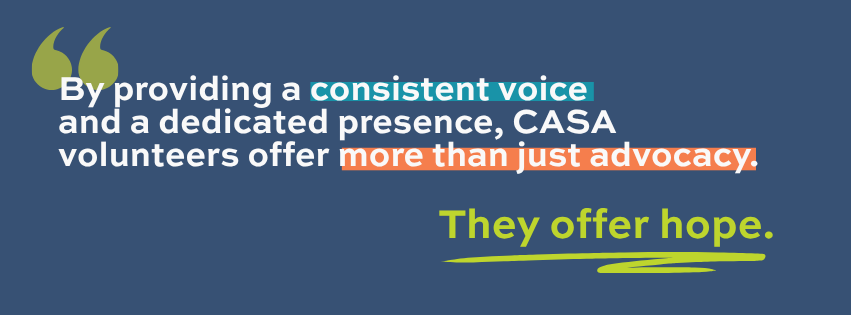
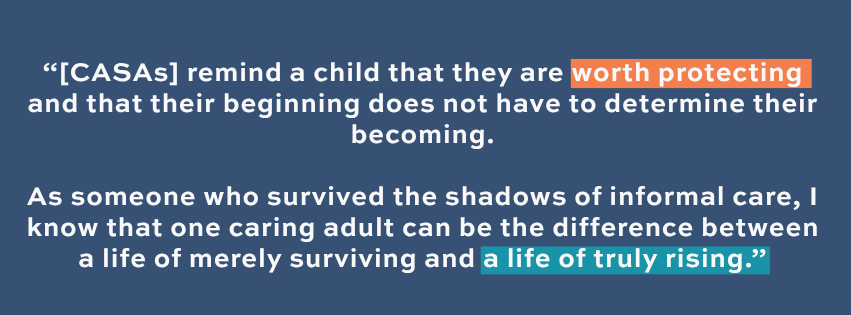
The work of CASA Los Angeles ensures that children don’t have to rely on luck to be seen. By providing a consistent voice and a dedicated presence, CASA volunteers offer more than just advocacy; they offer hope. They remind a child that they are worth protecting and that their beginning does not have to determine their becoming. As someone who survived the shadows of informal care, I know that one caring adult can be the difference between a life of merely surviving and a life of truly rising.
Be the difference. Support CASA LA.

Cynthia Goble is an author, professional speaker, and the founder of Rise and Resilience, LLC. An expe rienced leader in operations and human resources, she focuses her work on trauma-informed leadership and building human-centered organizational systems. Her debut memoir, Forever A Foster Child: A Memoir of Resilience, explores her journey through displacement and the enduring power of the human spirit. She is a dedicated advocate for children navigating instability and lives on the East Coast with her faithful companion, a Beagle named Mason.